Dangerous Tree Assessment and Removal: A Practical Overview
A dangerous tree rarely announces itself in a neat, obvious way. Sometimes the problem is dramatic, such as a storm-split stem hanging over a driveway. More often, risk builds quietly. A large limb extends farther each year over a roof. Old pruning wounds begin to decay. A trunk develops a seam that was easy to miss when the canopy was full. The work of dangerous tree assessment and removal sits right at that intersection of biology, structure, weather, and consequence.
That is why this topic deserves a practical treatment rather than a simple yes or no answer. Trees are valuable landscape assets. They provide shade, screening, scale, and character. At the same time, there is no completely safe tree. Some level of risk exists any time a large living structure stands near people, homes, vehicles, walkways, or utility corridors. Good ISA certified arborist consultation arboriculture does not pretend otherwise. It aims to identify, analyze, and evaluate risk, then recommend measures that reduce it to a level the site owner can reasonably accept.
In practice, that often means the best answer is not immediate removal. It may be Tree Pruning & Crown Shaping to reduce load on an overextended limb. It may be Tree Cable and Bracing to support a weak union while preserving the tree. It may be closer monitoring, especially if the tree occupies a low-use area. And sometimes, after careful assessment, removal is the sound and responsible choice.
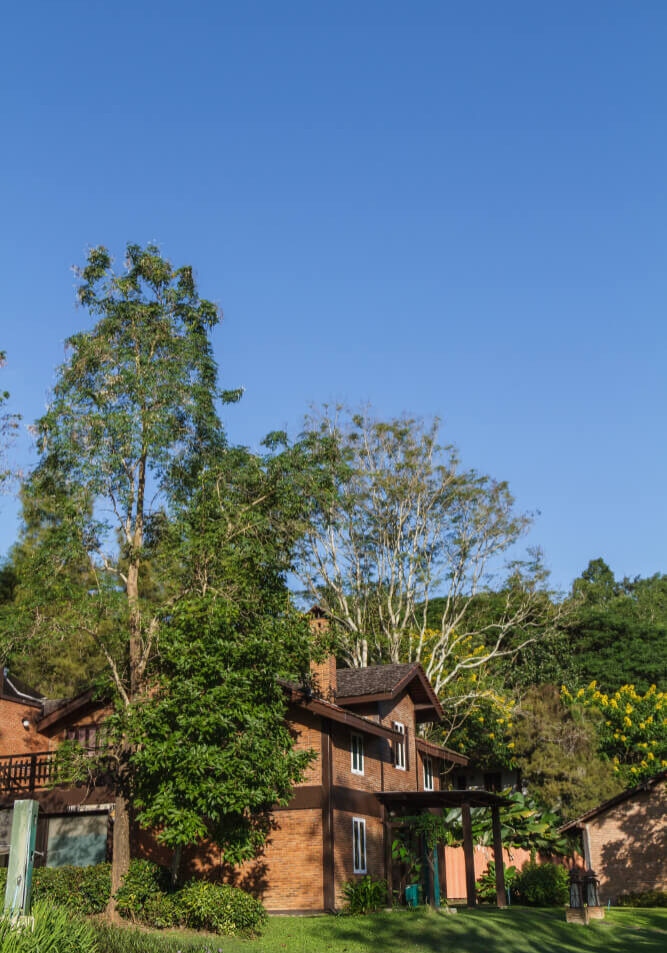
What makes a tree dangerous
People often use the word “dangerous” to describe any tree that looks large, old, messy, or inconvenient. That is understandable, but size alone is not a reliable measure. A tree becomes a meaningful concern when a structural weakness, defect, damage pattern, or decline issue combines with a likely target. In other words, a problem matters more when there is something valuable within reach of failure.
That distinction is central to Dangerous Tree Assessment and Removal. A dead stem in a fenced natural area may deserve attention, but it does not present the same urgency as a compromised tree over a front entry or school walkway. Likewise, a minor defect in a species that compartmentalizes decay well may call for observation rather than action. Judgment matters, and blanket rules usually fail.
The assessment process used by trained professionals is systematic. It is not guesswork, and it is not driven only by appearance. The goal is to understand what part of the tree might fail, how likely that failure is under expected conditions, what the tree might strike, and which mitigation options are realistic. Those options can include pruning, structural support, site use changes, monitoring, or Tree Removal Services.
A homeowner’s first instinct is often to ask, “Is it going to fall?” A better question is, “What is the actual risk here, and what can be done about it?” That change in language leads to better decisions and fewer unnecessary removals.
The role of a Certified Arborist Consultation
When stakes are high, a Certified Arborist Consultation is the starting point. That matters because the work is both technical and hazardous. Industry guidance is clear that pruning or removing trees, especially large trees, can be dangerous and should be handled by people who are trained and equipped to work safely in trees. The same guidance makes a point many property owners miss: an ISA Certified Arborist is not simply someone who owns a chainsaw and a truck. Certified Arborists are trained in the art and science of tree care, must pass a comprehensive exam, continue their education, and follow a code of ethics.
That training shows up in the quality of the questions asked on site. A capable arborist looks past the immediate defect and considers the whole situation. Is the issue recent storm damage, or a long-developing structural problem? Is the concern in the crown, at a branch union, in the trunk, or around the root zone? Has earlier pruning helped or made the tree less stable? Would directional pruning or crown reduction lower risk without stripping the tree of function? Is a support system realistic? Those are not cosmetic questions. They shape the recommendation.
Clients sometimes hope for certainty, but tree risk work rarely offers it. Trees are living organisms exposed to changing weather and site conditions. What a skilled arborist can offer is a defensible process and a recommendation grounded in established practice. That is far more useful than a casual opinion based on how a tree “looks.”
What a practical assessment actually looks at
A good assessment begins with observation and context. The arborist is trying to connect condition with consequence, not simply catalogue defects.
Typical points of attention include:
- Visible defects such as cracks, seams, deadwood, weak branch attachments, or storm damage
- Overall crown condition, including whether pruning history has improved or worsened structure
- The location of likely targets such as homes, parked cars, driveways, patios, or pedestrian areas
- Whether mitigation through pruning or structural support is feasible
- Whether the tree’s condition calls for monitoring, immediate action, or full removal
Even that short list can be misleading if read too mechanically. A crack high in the crown does not mean the same thing as decay at the base. A codominant stem over open lawn presents a different level of concern than the same stem over a child’s play area. A reduction cut performed correctly can lower risk. A topping cut or stub cut can create future problems. The details matter, and the details tend to reveal themselves only when the person evaluating the tree understands both structure and proper tree care standards.
This is one reason experienced arborists are often cautious with language. They know there is a difference between hazard, defect, and risk. A defect may be present without creating intolerable risk. A healthy-looking tree may still require intervention because of structure or target occupancy. Fast decisions made from the sidewalk are rarely the best ones.
Why pruning is often part of risk management
When property owners hear the phrase Tree Removal Services, they sometimes assume the assessment is only a path toward cutting the tree down. In well-managed tree care, removal is only one tool. Tree Pruning & Crown Shaping frequently plays a major role in reducing risk while preserving the tree’s value.
Proper pruning can reduce end weight on extended limbs, improve clearance, and guide future growth in a safer direction. Crown reduction and directional pruning are especially relevant where the goal is to shorten leverage on overreaching branches or move growth away from targets. Raising the crown may improve clearance over access areas. Each technique has a purpose, and each depends on correct cuts.
That last point deserves emphasis. Industry guidance warns against improper methods such as topping and stub cuts. Those practices may create the appearance of quick control, but they do not represent sound risk management. They can leave a tree disfigured, stressed, and structurally worse over time. For dangerous-tree work, “less tree” is not automatically “safer tree.” The pruning has to be done in a way that respects biology and structure.
A practical example helps. If a mature tree has one overextended lateral branch above a garage, the right response may be to reduce that branch to a suitable lateral and rebalance the crown. If the same tree has multiple serious structural defects throughout the canopy and trunk, pruning may only postpone the inevitable while leaving the owner with repeated costs. This is where professional judgment earns its keep.
When Tree Cable and Bracing make sense
Not every weak union or structurally concerning limb should trigger a removal recommendation. Tree Cable and Bracing can be appropriate in selected cases, particularly when the tree has high landscape value and the defect can be managed rather than ignored.
The basic idea is straightforward. Structural support systems help reduce movement or share load in parts of the tree that show weakness. They are not magic, and they are not a substitute for assessment. They are one of several treatments an arborist may consider as part of risk reduction. In many cases, support systems work best alongside thoughtful pruning, because reducing load and installing support address the problem from two directions.
What support systems do not do is make a compromised tree permanently worry-free. They require professional design, installation, and follow-up. They also assume the defect is one that can reasonably be mitigated. If the trunk is failing at the base, or if decline is too advanced, cables and braces may offer little real benefit.
Property owners sometimes resist support work because it feels less final than removal. That is true, and it should be discussed plainly. Support systems preserve a tree, but they also commit the owner to ongoing care. On the right tree, that is a worthwhile trade. On the wrong tree, it delays a removal that should have happened sooner.
Storm damage changes the timeline
A tree that was tolerable yesterday can become urgent after one heavy storm. Wind, snow load, or ice can expose hidden weaknesses very quickly. A split stem, a partially failed limb, or a root plate that has begun to lift creates a different level of concern than a static defect noted during routine maintenance. This is where Emergency Tree Services become essential.
Emergency response work is not just regular tree work done faster. The hazards multiply when wood is loaded under tension, hanging above structures, or entangled in neighboring branches. A limb that appears still can shift without warning. A damaged crown may require controlled lowering techniques rather than simple cutting. This is one reason trained, equipped crews are so important. Emergency service restoration is recognized within arboricultural standards for a reason. The work demands careful control under unstable conditions.
From the client side, urgency can create pressure to make decisions with incomplete information. That is understandable after a storm, especially when access is blocked or there is visible damage over a home. Even then, the best providers separate the immediate emergency response from the broader management question. First, stabilize the site and remove imminent danger. Then decide whether the remaining tree can be retained with pruning or support, or whether full removal is the prudent next step.
Removal is sometimes the right answer
For all the value of preservation, some trees should come down. A defensible removal recommendation usually rests on a combination of significant defect, limited mitigation options, and unacceptable exposure to people or property. That is where Tree Removal Services are not a last resort born of convenience, but a deliberate risk management decision.
Large-tree removal is specialized work. It may require sectional dismantling, controlled rigging, and careful lowering of material to protect structures and site features. That operational side matters because dangerous-tree removal often happens in tight spaces where there is little margin for error. A tree with compromised structure can be more difficult to remove safely than a healthy one. Weak wood does not always behave predictably, which is another reason this work belongs in trained hands.
There is also the emotional side. Owners often have a history with the tree. It shaded the house for years, anchored the front yard, or marked a property line long before the current owner moved in. Good professionals recognize that removal can feel like a loss, even when it is clearly justified. Explaining why the recommendation is being made, and why lesser interventions would not adequately manage the risk, is part of the job.
Do not forget the stump
After removal, many people are surprised by how much the stump affects use of the site. It can remain as a visual reminder, interfere with mowing or replanting, and continue to occupy valuable space. That is where Stump Removal & Grinding becomes part of the broader discussion.
Whether a stump is removed immediately or later depends on goals for the site. If the area will be replanted, regraded, or converted to lawn or hardscape, grinding is often the practical choice. If the stump sits well out of the way, some owners choose to delay. The important point is that stump work is not an afterthought. It should be considered as part of the overall scope when discussing dangerous-tree removal, especially if roots, access, and future use matter to the owner.
Fire exposure and vegetation management
In fire-prone regions, risk management around trees expands beyond failure and impact. FireSmart Tree Services are part of a larger conversation about how vegetation is arranged, maintained, and managed near structures. While dangerous-tree assessment focuses on structural defects and targets, fire-minded tree care looks at how tree condition and placement contribute to the vulnerability of the site.
That does not mean every tree near a home should be removed. Just as with storm risk, the better approach is selective and informed. Pruning may improve separation and reduce problematic growth patterns. Removal may be appropriate where a tree is poorly placed or impossible to manage safely. The value of a professional consultation is that it connects tree care decisions to the real conditions of the property, rather than treating every tree as either harmless or expendable.
Signs that deserve prompt attention
Some situations justify a faster call for professional assessment, especially when the tree stands near a place people use every day.
Watch for conditions such as:
- A newly cracked stem or a branch union that appears to be separating
- Hanging limbs after wind, snow, or ice events
- Sudden lean changes or soil movement near the base
- Obvious dead sections over roofs, walkways, or parking areas
- Storm-damaged trees where broken parts are still suspended in the canopy
These are not do-it-yourself invitations. They are signals to keep people clear and bring in qualified help. Large-tree pruning and removal are dangerous operations even under calm conditions. Add storm damage, compromised wood, or nearby structures, and the need for trained crews becomes even more obvious.
What good recommendations sound like
One of the easiest ways to judge the quality of a dangerous-tree assessment is to listen for nuance. Sound advice rarely starts with a sales pitch for the most drastic service on the menu. It usually sounds more like this: here is the defect, here is why it matters on this site, here are the management options, and here is why one option is preferable.
Sometimes that recommendation is pruning and monitoring. Sometimes it includes Tree Cable and Bracing. Sometimes Emergency Tree Services are needed right away. Sometimes the answer is unequivocal removal, followed by Stump Removal & Grinding to restore use of the area. A careful arborist should be able to explain those choices in plain language without overselling certainty.
That measured approach reflects something tree professionals learn early and never outgrow. Every tree carries some risk, and every intervention carries trade-offs. Remove too quickly, and you may lose a tree that could have been retained safely with proper care. Wait too long, and the cost of delay may be a preventable failure. The value of professional Dangerous Tree Assessment and Removal lies in navigating that middle ground with discipline, safety, and respect for both the tree and the people living around it.
For property owners, that means the smartest first step is not guessing from the driveway or relying on the neighbor who once cut down a maple. It is arranging a Certified Arborist Consultation, asking for a clear explanation of the risk, and weighing the recommendation against the real use of the site. When that process is done well, the result is not just a cut tree or a trimmed canopy. It is a decision you can defend, because it was made with care.
Name: Ace Tree Services Ltd.
Address: 4656 Wallace Hill Road, Kelowna, BC
Phone: 250-212-9593
Website: https://acetree.ca/
Hours:
Monday: 7:00 AM–5:00 PM
Tuesday: 7:00 AM–5:00 PM
Wednesday: 7:00 AM–5:00 PM
Thursday: 7:00 AM–5:00 PM
Friday: 7:00 AM–5:00 PM
Saturday: 7:00 AM–5:00 PM
Sunday: Closed
Emergency tree services: 24/7 emergency service is listed.
Open-location code / Plus code: RHF8+8G Kelowna, British Columbia, Canada
Map/listing URL: https://www.google.com/maps/place/Ace+Tree+Services+Ltd./@49.8232606,-119.4337283,563m/data=!3m1!1e3!4m6!3m5!1s0x537d8b1d074815c5:0x450b88afa7a41435!8m2!3d49.8232606!4d-119.4337283!16s%2Fg%2F11ydkpnh22
Embed iframe:
Socials: https://www.facebook.com/people/Ace-Tree-Services/61585901931447/
https://m.yelp.com/biz/ace-tree-services-kelowna
Ace Tree Services Ltd. provides professional tree service for residential, commercial, and municipal customers in Kelowna and across the Okanagan Valley.
The company’s listed services include tree removal, stump removal and grinding, tree pruning and crown shaping, emergency tree services, certified arborist consultation, dangerous tree assessment, tree cable and bracing, and wildfire mitigation.
Ace Tree Services works with homeowners, businesses, property managers, and public-sector clients that need safe, practical tree care in the Kelowna area.
The official site highlights ISA-certified arborists, insurance, and experience handling both routine and complex tree service situations.
Customers can contact Ace Tree Services for tree care planning, hazard concerns, emergency tree cleanup, pruning needs, stump grinding, or advice about trees near homes, fences, driveways, and landscaping.
Ace Tree Services lists regular work hours from 7:00 AM to 5:00 PM Monday through Friday, with 24/7 emergency tree service available for urgent situations.
For tree service in Kelowna, call 250-212-9593 or visit https://acetree.ca/
The public map listing places Ace Tree Services Ltd. in Kelowna and can help customers find directions to the Wallace Hill Road area.
Popular Questions About Ace Tree Services Ltd.
What services does Ace Tree Services Ltd. provide?
Ace Tree Services Ltd. provides tree removal, stump removal and grinding, tree pruning and crown shaping, emergency tree services, certified arborist consultation, dangerous tree assessment and removal, tree cable and bracing, and wildfire mitigation.
Where is Ace Tree Services Ltd. located?
The official website lists Ace Tree Services Ltd. at 4656 Wallace Hill Road, Kelowna, BC.
What areas does Ace Tree Services Ltd. serve?
The official website describes Ace Tree Services as located in Kelowna and servicing the Okanagan.
What phone number should customers call?
Customers can call Ace Tree Services Ltd. at 250-212-9593.
What are Ace Tree Services Ltd.’s regular hours?
The official website lists work hours as 7:00 AM to 5:00 PM, Monday through Friday. Saturday and Sunday regular hours are not listed and should be confirmed directly.
Does Ace Tree Services Ltd. offer emergency tree service?
Yes. The official website lists 24/7 emergency services for urgent tree situations, including emergency tree removal, dangerous tree assessment, stabilization, and limb or branch cleanup.
Does Ace Tree Services Ltd. have certified arborists?
Yes. The official website states that Ace Tree Services has ISA-certified arborists.
Can Ace Tree Services Ltd. help with wildfire mitigation?
Yes. Wildfire mitigation is listed as one of the company’s tree services.
How do I contact Ace Tree Services Ltd.?
Call 250-212-9593 or visit https://acetree.ca/.
Landmarks Near Kelowna, BC
Wallace Hill Road: A local Kelowna road near the address listed for Ace Tree Services Ltd.
Okanagan Lake: A major Kelowna landmark near residential, commercial, and waterfront properties that may need tree pruning, removal, or hazard assessment.
Downtown Kelowna: A central area with homes, offices, rental properties, restaurants, and commercial sites that may need professional tree care.
Mission / Lower Mission: A well-known Kelowna area with mature landscaping, residential properties, and lake-adjacent homes.
South East Kelowna: A rural and residential area with larger properties, orchards, and tree-care needs that can include pruning, removals, and wildfire mitigation.
Crawford: A residential area near the southeast side of Kelowna where homeowners may need tree trimming, hazard assessment, and stump grinding.
Kettle Valley: A hillside residential neighborhood where tree condition, slope, wind exposure, and defensible-space planning can matter for property owners.
Myra-Bellevue Provincial Park: A major outdoor landmark near southeast Kelowna and a useful point of orientation for nearby properties.
Gallagher’s Canyon: A residential and golf community near southeast Kelowna where tree maintenance and wildfire-conscious vegetation management can be practical concerns.
Orchard Park Shopping Centre: A major central Kelowna retail landmark and reference point for customers traveling across the city.
Highway 97: A major Kelowna corridor connecting neighborhoods, commercial properties, and service routes throughout the region.
Kelowna City Park: A recognizable central landmark near downtown neighborhoods and lakefront properties.
Glenmore: A Kelowna neighborhood with residential and commercial properties that may need pruning, storm cleanup, and general tree care.
Rutland: A large residential and commercial area where customers may need tree removal, pruning, stump grinding, or arborist consultation.
Black Mountain: A hillside community where slope, wind, wildfire exposure, and access can influence tree service planning.
For tree service near these Kelowna landmarks, contact Ace Tree Services Ltd. at 250-212-9593 or visit https://acetree.ca/